
Sapulpa City Directory Holdings
The strongest Sapulpa starting point is the historical shelf rather than a promised all-years database. The Sapulpa Historical Society describes Hoffine's and Polk's volumes with verified examples from 1907, 1911, 1916, and 1920 through 1975, while a genealogy-page description reports old Sapulpa directory holdings from about 1907 to 2000. Those statements do not prove that every annual volume survives. Call before a Sapulpa visit, record the exact year and publisher used, and treat gaps as gaps.
| Collection | Years reported | Where held | How to use it |
|---|---|---|---|
| Hoffine's and Polk's Sapulpa city directories | Examples: 1907, 1911, 1916, 1920–1975 | Sapulpa Historical Society/Museum | Contact the museum to confirm the physical volume and access |
| Historical Society directory holdings | About 1907–2000 reported | Museum, 100 E Lee | Availability should be confirmed by phone |
| Reported directory digitization | 1907–2009 project scope | Sapulpa Historical Society | Project status and public search access are unconfirmed |
| Annual Oklahoma directories | City and year search | Oklahoma Historical Society Research Center | Use the Research Center when no scan appears |
The Sapulpa collection mix matters. Old telephone books, school photos, yearbooks, and Herald microfilm are also reported at the Sapulpa museum or library, but their exact year runs are not published. They work best as companion evidence when a directory leaves a blank year or a surname changes.
Sapulpa Genealogy Room Directories
Sapulpa's Bartlett-Carnegie Public Library keeps its genealogy department on the first floor, with microfilm and microfiche as well as genealogy databases. Its genealogy hours are Monday through Friday, 9 to 1, plus the first and last Saturday from 10 to 2. The general library hours are longer, but the Sapulpa research-room schedule is the useful one for an old directory search. The genealogy desk can be reached at 918-248-5979 or SPLgen@sapulpaok.gov, and interlibrary loan is available.
Bartlett-Carnegie Public Library's genealogy information identifies the local microfilm, microfiche, and research resources. Bring the name variants and years already found. That gives staff a practical starting point without assuming a missing volume was never published.
The library resource view supports an in-person approach when the needed directory or its companion newspaper record is not searchable online.
Its online catalog labels some electronic resources for in-library use only, including Fold3 and American Ancestors. The catalog also showed a temporary electronic-access suspension notice during research, so confirm availability before relying on a database for a visit.
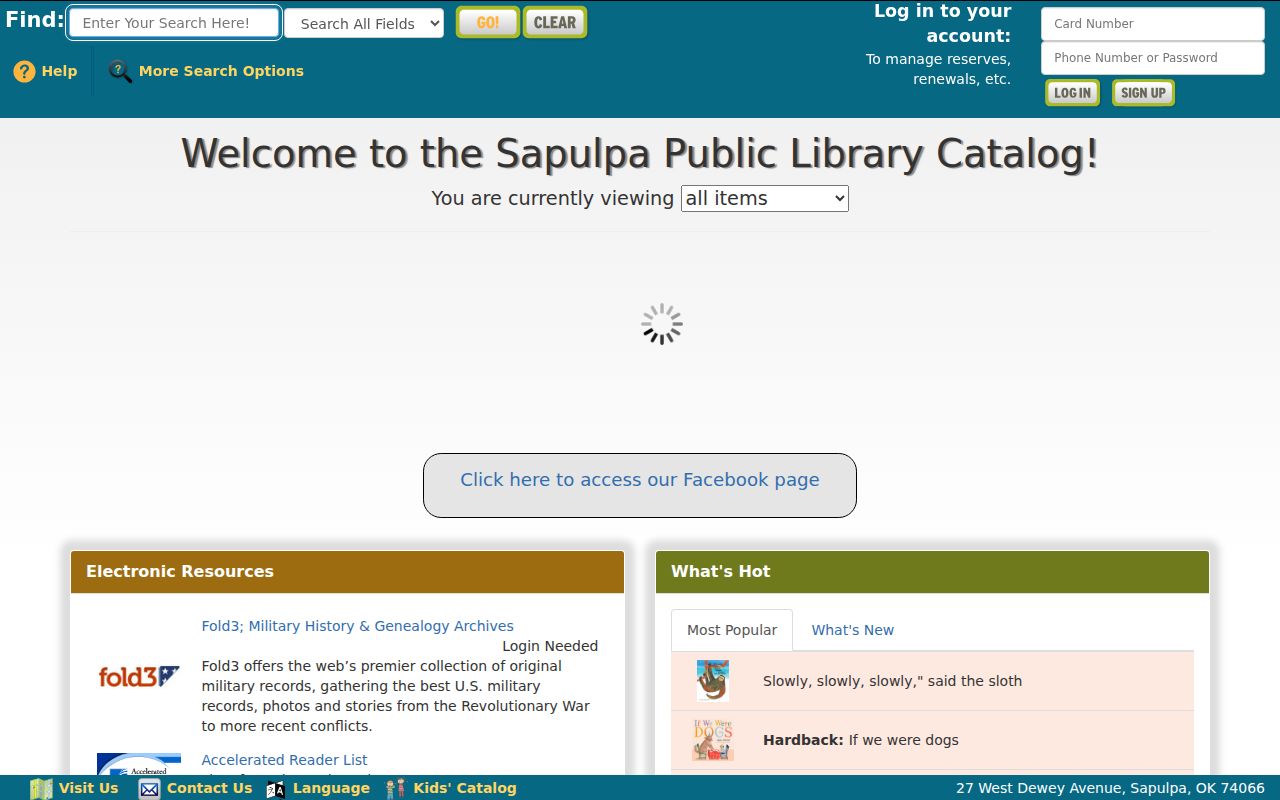
Catalog labels describe Sapulpa access conditions, not a complete digital run of Sapulpa directories.
Sapulpa Museum Directory Volumes
The Sapulpa Historical Society/Museum at 100 E Lee is the key local contact for the older directory shelf, telephone books, yearbooks, and Herald microfilm. Its reported hours are Tuesday through Saturday, 10 to 3, and its phone is 918-224-4871. The Sapulpa museum's own explanation of directory entries is especially useful because it describes the local form, instead of applying a generic city-directory rule to Sapulpa.
The Historical Society and Museum also maintains current exhibit information. Ask staff for the directory year, a matching telephone book, obituary leads, map guidance, and any available plat or deed context. A volume can identify an address, but it should not be used alone to settle ownership or every member of a household.
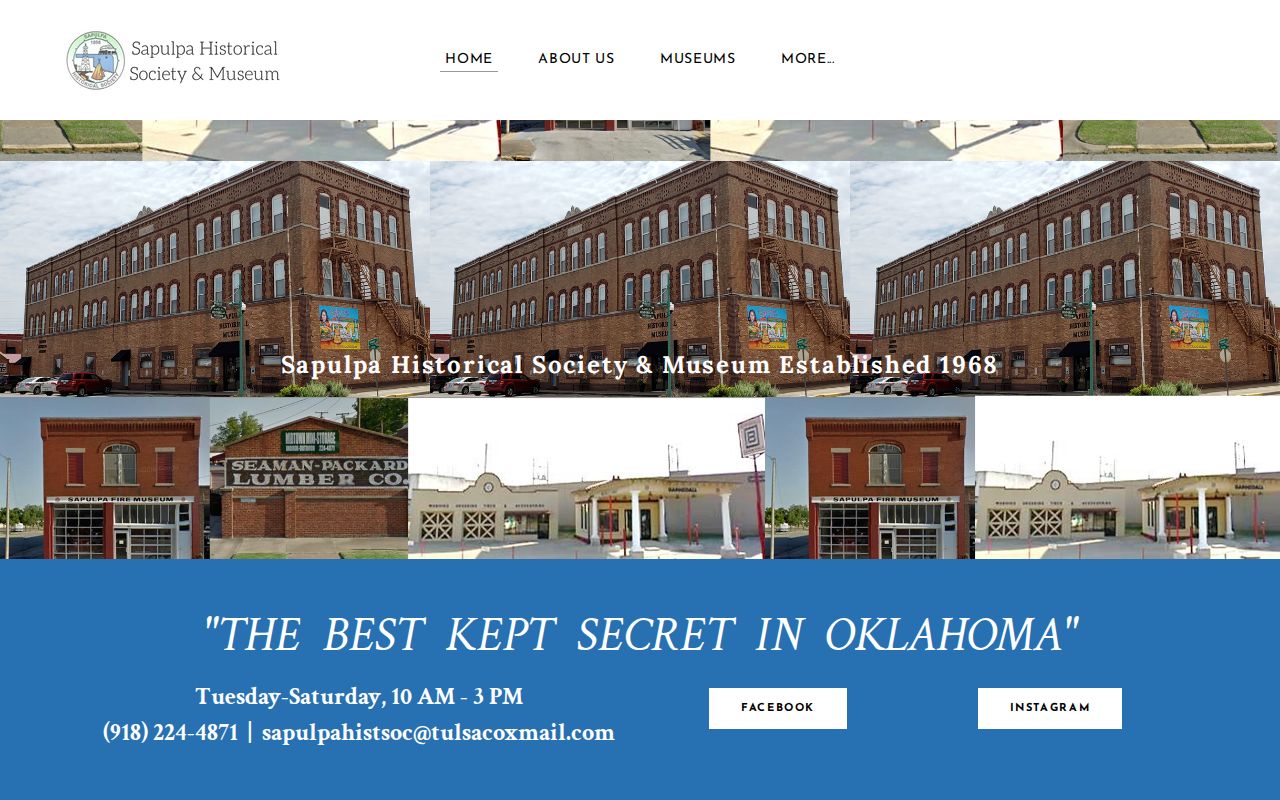
The museum is a Sapulpa access point for the physical sources that fill gaps between online record systems.
Reading a Sapulpa City Directory Entry
A Sapulpa historical entry is compact, yet it can carry several leads. The Historical Society reports a headword name, a spouse in parentheses, an occupation, a home address, and a phone number when one was available. Widow notation and other abbreviations can help separate people with the same surname. Sapulpa business and residence lines may be separate. Photograph or transcribe the printed form first, then add a normalized spelling in your notes.
| Name | The household headword or listed name, sometimes with initials |
|---|---|
| Spouse clue | A spouse may appear in parentheses after the name |
| Occupation | An occupation and a printed location may appear |
| Residence | A street address and, when available, telephone number |
| Status notation | Widow notation or another abbreviation; any status marks need volume-by-volume confirmation |
- Criss-cross directory
- A reverse section organized by street and address rather than by a resident name.
- Householder index
- An index that points to listed household names; it may omit other people at the address.
- Abbreviation key
- The volume's guide to short forms. The Society reports carp for carpenter, mgr for manager, and wid for widow.
The pre-1960s notation (c) is a historical racial classification marker in these volumes. Preserve it only as a description of the original index, never as a modern category. Note: a directory can omit children and some married women, so its listings do not equal a census household.
Sapulpa Historical Directory Digitization
A Sapulpa Historical Society article reports a collection-manager homework project to digitize Sapulpa City Directories from 1907 to 2009. That is a promising lead, not proof of a live searchable collection. The Sapulpa project status, completeness, and public access were not independently confirmed. Search the existing physical holdings first, then ask the museum whether any scans or indexes can be consulted.
The reported Sapulpa directory digitization project should be cited as a reported initiative. It is not a reason to skip a call, a library visit, or an OHS Research Center request when no scan is visible.
The holdings source documents the local directory structure and the need to verify what is currently available.
Trace Sapulpa City Directories by Year
Use a Sapulpa sequence, not one hit. Begin with the surname and a given name, then preserve the directory year, publisher, page, spouse marker, address, phone, and abbreviation. A move, a new spouse notation, or a changed initials pattern may be the link to the next Sapulpa record. The official Oklahoma Historical Society City Directory Search offers City and Year fields and directs researchers to the Research Center when no scan is shown.
- Find the earliest reliable listing and capture its printed spelling and address.
- Check the next available Sapulpa volume, then note any move, disappearance, or changed household marker.
- Read the street-order section or nearby address sequence when a reverse volume is available.
- Pair observations with the nearest released federal census, using the directory address as a lead rather than assuming both systems used identical geography.
- Use a Herald obituary, probate filing, deed, or map to test a death, relocation, or ownership change.
Federal censuses from 1900 through 1950 are released, with later decennial years following the 72-year public-release rule. Census entries can restore Sapulpa household members absent from a directory, but Sapulpa street numbering and geographic labels can differ. For a modern address-keyed record trail, use the Sapulpa street directory lookup after the historical address has been normalized.
Sapulpa Directory Counts Need Context
A 1910s Hoffine volume reportedly contained 4,803 names. The Sapulpa Historical Society source multiplied that number by three to offer a cautious estimate of 14,412 people, while also warning that children and married women could be omitted. The figure helps describe the size of an indexing effort during Sapulpa's early growth. It cannot be treated as a Sapulpa head count or a complete resident roll.
This is why a historical volume works best as a time-stamped lead. A listed name can lead to a spouse, a street, or an occupation, then those details can be checked against the census, newspapers, and land records. Missing from a volume may mean a move, an omission, or a different listing form.
Keep a short source note for each observation: the volume title, year, page, printed name, and address. That small record makes it much easier to revisit a finding when a later census, deed, or obituary changes the interpretation.
Sapulpa Directory Search Quirks
Local Sapulpa examples show why exact-string searching fails. The 1907 directory records 28½ E Dewey as the Empress Theatre, while Max Meyer does not appear until 1908. A later Sapulpa business or person should not be placed at that address merely because the building appears in an earlier volume. Old fractions, East and West labels, P.O. boxes, initials, and historic street terms all belong in a variant log.
Sapulpa newspaper research adds another warning: a historical item used the spelling “Johonnis” for Fred Johannes. Search both forms in Sapulpa newspaper OCR and preserve the source spelling when recording a result. Note: use the address, printed date, and surrounding entries together before deciding that two similarly named listings concern the same person.
Sapulpa City Directory Address Checks
The Library of Congress Sapulpa Sanborn set is an April 1911, 11-sheet snapshot of building outlines, streets, block numbers, materials, and use. It can help determine whether the built setting and block fit the address printed in a city directory. It does not prove who lived in a building. Record the sheet number and compare the street and block rather than treating the map as an occupant list.
When a Sapulpa directory address and a later deed seem to conflict, reconcile the legal description. The Sapulpa Anderson example follows Roy and Katye Anderson through 1930–34 Sapulpa directories, later censuses, San Jose, and a 1962 deed, but that deed named Payne County even though the land was in Sapulpa and Creek County. Lot, block, addition, and other legal-description details are stronger Sapulpa cross-checks than a county name printed in isolation.